
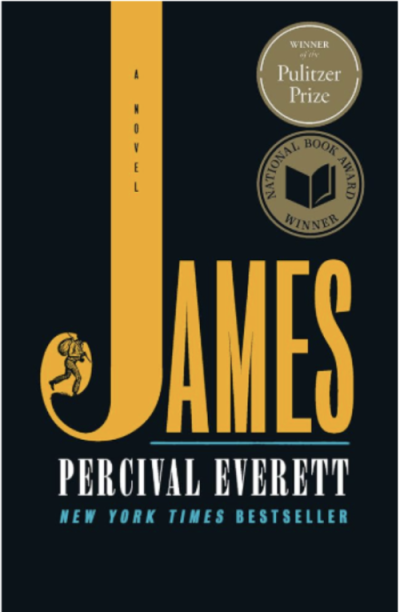
As December 2025 came to an end, I found myself in a similar situation to the majority of the world: writing my New Year’s Resolutions. Coming in first on my extensive list of demands for myself was simple. To read more. So, as January 1st, 2026 rolled around, I took myself to the bookstore and purchased James by Percival Everett.
Everett does the impossible. Often, artists are chastised for tackling the task of reimagining a literary classic. Despite these canonized works often being riddled with controversies, they are lauded as sacred and holy works that are not to be touched. However, all should commend Everett for enduring that stigma, for this novel is incredible.
Rewritten to be from the perspective of James, the runaway slave Huckleberry encounters while escaping to Jackson Island and later down the Mississippi River, it transforms Twain’s one dimensional creation of James into an intellectual, multi-faceted character. James is witty and philosophical, charismatic and insightful. He debates Locke and Rousseau, he sings his way into freedom and reveals that his broken grammar was never broken at all—only strategically deployed.
With Huckleberry Finn no longer the protagonist, James is his protector and is forced to grapple between his freedom, his daughter and Finn. He endures degrading circumstances, approaches death, all while chasing his dream of becoming a writer. Everett doesn’t just modernize Huck Finn. He interrogates it, reclaiming the story from the character the original made unforgettable but never fully heard.
Brilliant, unsettling, and provocative, James is an exceptional novel: one that sets the bar almost impossibly high for the remainder of my reading list to follow. Everett proves that when a “classic” is built on something broken, the only honest thing to do is reinvent the wheel entirely.