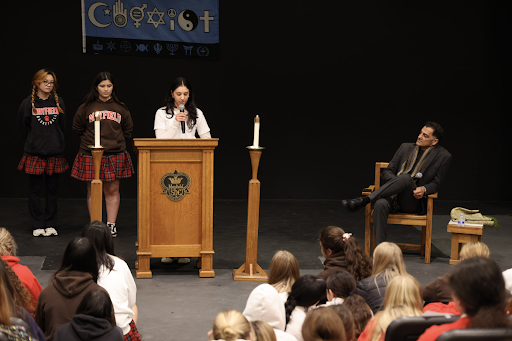
Have you ever wondered about the Islamic faith? This year, students, faculty, and teachers sat in Pike Auditorium to hear from Muslim Public Affairs Council President Salam Al-Marayati for the Interfaith Prayer Service this year. According to the Muslim Public Affairs Council,, Al-Maryati is “an expert on Islam in the West, Muslim reform movements, human rights, democracy, national security, and Middle East politics. He has spoken at the White House, Capitol Hill and represented the U.S. at international human rights and religious freedom conferences.”
During the service, Al-Marayati explained how Islamic traditions and beliefs often lead to misconceptions about the faith. He also taught the importance of respect for people with other traditions despite their differences. Al-Maryati closed off the service with a prayer and gave students and teachers a new light on the Islamic faith.
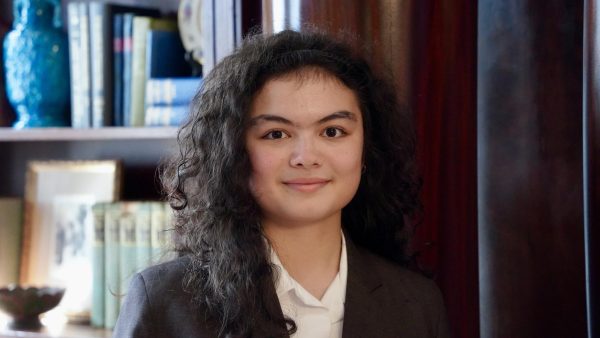
Behind the scenes, Aliyah Husaini planned the service. Husaini is the founder of the Muslim Students Association (MSA) which is one of the affinity spaces at Mayfield. We asked her a few questions to learn more about the service.
Crier: Could you tell us more about Al-Marayati?
Aliyah: [Al-Maryati] is the president and co-founder of this organization called Muslim Public Affairs Council, and we work to increase advocacy and representation of American Muslims and Muslims worldwide. He is very impactful, very important, and he’s one of the most important people there. They’re getting more into politics, they’re helping people who have been wrongfully accused and wrongfully treated, and his work is really important. He’s really good at cultivating the youth, which I think was really nice to see, because he himself always says that he would rather be with the youth than going to the White House or going to Capitol Hill. So, yeah, he’s a really important person.
Crier: What was your goal for the interfaith prayer service?
Aliyah: This year, I founded the Muslim Student Association. Our mission is to create a safe space for Muslim students who are already here, to introduce people to the faith, bring more awareness about it, and welcome people who might be interested in it. So, by having this event, it’s nice to expose people to what Islam really is, rather than all the misconceptions, because there are so many out there that are completely false. I think it was really important to not only show misconceptions, but also the similarities between Christianity, Catholicism, and Islam, because really there are so many that people don’t realize. I think everyday things and things that people relate to are really important to expose and show to the world, because I feel like Islam is portrayed as something that’s really foreign, different, and other, even though it’s not. It’s just a lifestyle, it’s how you live. It’s less being detached from the world, and more that it really actually encourages being in the world. It tells you how to live your life in a realistic way, and I feel like that was really important so that people could relate with it and understand it. So that’s really what I wanted to achieve with that event.
Crier: Is there anything else you have to say?
Aliya: I think it’s really important that if you are hearing misconceptions or hearing things that seem wild, that you look into it and actually go to see if it’s really true or not, because it completely makes sense when people hear things on the news, or maybe they hear it from people, they trust that they’ll believe what they say. It makes complete sense; I do it, everyone does it. If you really understand the core of Islam, you can understand that a lot of these things have nothing to do with Islam itself. Oftentimes, a lot of the things that are bad or evil, or harmful to others, are cultural traditions. Cultural things rather than actual religion, so I think also distinguishing between cultural traditions and actual religion. It’s a really, really important thing for people to understand, because people are gonna be people. Not everyone is gonna really accurately portray their religion in a perfect way. That’s how it is in every religion. There are plenty of people in Islam who have completely wrongfully represented the religion itself, and there are people in Christianity and Catholicism who don’t represent the morals and the values that Christianity upholds. So I feel that understanding the difference between culture and actual religion, and also understanding how ultimately we all have humanity in us