Social Media. Surely, all teenagers have heard (and rolled their eyes at) their parents on their soap boxes preaching about the ‘good ol’ days’ when instagram, Tiktok, and the like did not exist. Though there are undoubtable benefits of social media, e.g. in support of small business, there also seems to be a consensus on the damages it can cause, particularly in respect to the younger generations. Currently, one of the most concerning issues is social media’s ability to radicalize its users, particularly adolescents, by creating “echo chambers” reinforced by cognitive biases. After all, everyone likes for their opinion to be reaffirmed by others, right? The issue, however, is when the only opinion one hears is their own; brick by brick it will build the path to radicalization, manifesting in the recent uptick in political violence and extremism. Whether it’s the assasination of right-wing extremist Charlie Kirk, the continued school shootings that occur all over the country, or the banning of books that feature LGBTQ+ figures and characters, it seems that political opinion is now more divisive and devastating than ever. What’s more, each successive wave of extremist violence begets tsunamis of protests and online political fist fights. As a result, what constitutes protected free speech under the Constitution has been increasingly tested in the past few months.
As for schools, public ones have a much broader range of protection in regards to freedom of speech. In particular, the “New Voices” law heavily restricts censorship for the press in Californian public high schools, empowering the student to have the final say in publication. Following California’s lead, Eighteen states have passed New Voices legislation and several more have active bills to protect student journalism.
New Voices, and similar laws It’s a law that many states are trying to emulate, seek to bolster freedom of the press in their schools. For private schools like ours, freedom of speech is also protected, though to a lesser extent. California is actually one of the two states (out of 50!) that protects student journalists in private schools: “School officials cannot censor student media in California except if the media… Is obscene, libelous or slanderous.” As a religious school, understandably, we face more restrictions. Ultimately, the decision of what gets published and what doesn’t is up to the school administration.
But what does this mean for the Mayfield Crier, our school Newspaper? Will our freedom of speech continue to be protected, even if we attempt to discuss potentially controversial or inflammatory topics? What does our school’s administration think in regards to extremism, political opinion, and our newspapers’ role in the community? We asked Dr. Mabel Wong, the Mayfield’s new assistant head of school, to get her view of things.
Dr. Wong originally grew up in Singapore, a country where freedom of speech— though protected by their constitution— is tightly regulated by the government. For a moment Dr. Wong hesitantly considered whether she could even discuss the topic: “Maybe I shouldn’t even say it because they would disagree,’ Dr. Wong said during the interview. “And the fact that I’m worried that I just said it on something that’s recorded tells you something about the politics in Singapore.”
Indeed, growing up in a country and culture where freedom of expression or assembly is tightly regulated seems to have affected Dr. Wong’s understanding of the relationship the government has with its people in securing their natural rights. It has also shaped her opinion on school newspapers: “We didn’t have school newspapers in schools, so it was not something that I engaged with until I got to college” where she earned her undergraduate degree in media studies. She later received her PhD in political science. In brief, Dr. Wong’s interest in the newspaper is “always through the lens of politics.”
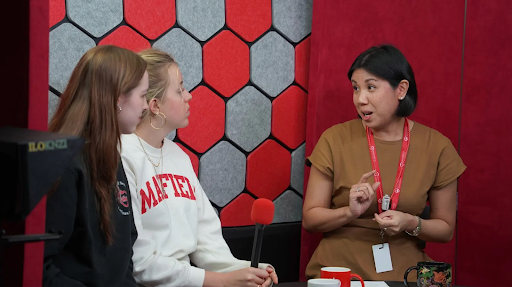
So, as Sofia Hesling and I sat down for the interview in the Media Room, we considered the questions that would be most relevant to the paper and the relation it has with the greater Mayfield community. As such, we first discussed the rise of extremism in the media and state of our country and asked Dr. Wong if the Mayfield Crier could, or should, report on subjects that could potentially be divisive or cause tension within our school. In response, she tested us on our knowledge of the First Amendment and the specific rights it contains (there are five!).
This amendment, noted Dr. Wong, is a “legal protection protected by the constitution and executed or implemented by the government.” With this definition, she said, we are now equipped to start unraveling how it applies to a private school such as our own: “We are a little bit removed from the federal government,” and as such the “legal application doesn’t apply as much as the culture does.” As for potentially controversial articles or opinions, Dr. Wong stressed that difference in itself should not be considered controversial, and that differing opinions can actually have a positive effect on the community by fueling informed discussions and building more diversified perspectives all around.
In this light, we asked Dr. Wong to clarify the extent of political opinion that should be published and, subsequently, the role of a newspaper in regards to the institution it writes for. Dr. Wong affirmed that it is Mayfield’s “responsibility to equip our students with critical thinking, speaking, and listening skills that go towards helping students talk about these issues and engage in these issues,” Dr. Wong said. “I also think that as an educator we have a responsibility to help our students process information in an accurate, thoughtful, critical way in order to arrive at your own positions.” So, writing about conventionally controversial topics isn’t really the issue here: it’s writing in a professional, data-driven, and positive way to foment constructive change in the Mayfield community.
As a private, all-girls Catholic school, however, there are more guiding principles that we should consider with every article we publish, noted Dr. Wong. This makes sense though; if the newspaper’s primary role is to build community— as Dr. Wong argued— it should align with the school’s values and mission. How else could we hope to create an open-minded environment for discourse and engage the members of our community? Ultimately, Dr. Wong, Sofia, and I agreed that what we write in our newspaper “should be in service of political engagement, a sense of unity, a sense of belonging.”
Sofia and I, as well as the rest of the Crier staff, were gratefully reassured throughout the interview that, despite the political landscape of our country at this moment, freedom of speech is protected and encouraged within our newspaper, our little hub of self advocacy and expression. But, as cliche as it sounds, with great power comes great responsibility. So, whether we are writing about recent ICE raids or the government shutdown, the journalists here at the Mayfield Crier will do our due diligence in fact-checking our sources, in writing with intention and compassion, and with the purpose of nurturing civil and supporting conversations at Mayfield.